Not in a Straight Line
Cincinnati marched for the first time in 1973, but Pride hasn’t been held every year since. Here is why the count gets confusing.
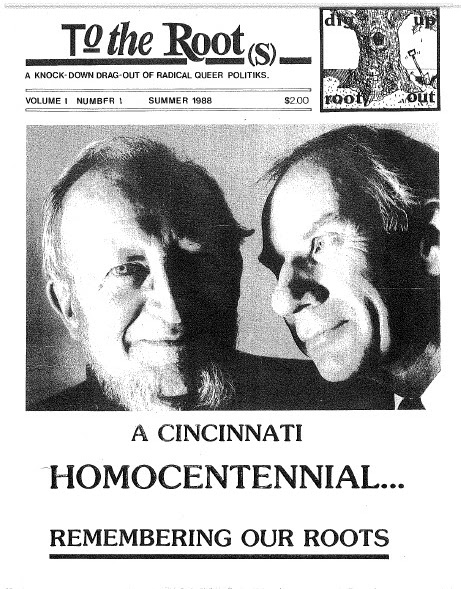
Ask when Cincinnati Pride began and you’ll get a clear answer: April 7, 1973, when members of the Cincinnati Gay Community marched from Washington Park to Fountain Square. Ask how many Prides there have been and the answer gets harder, because there wasn’t a parade every year.
There were two long breaks.
1974–1977. The founding group, the Cincinnati Gay Community, dissolved shortly after the 1973 march. Pride didn’t return until 1978, when the Greater Cincinnati Gay Coalition revived it and Mayor Jerry Springer proclaimed Lesbian/Gay Pride Day.
1996–1999. There was no formal parade or march for four years. Pride still happened in smaller ways: an hour on Fountain Square called “Pride Alive,” sponsored by the LGBT Center; “Aware on the Square”; June festivals at Lunken Playfield in Mt. Washington; and a small demonstration outside City Hall in June 1999, hosted by Michael Blankenship and attended by the late Dr. Larry Wolf.
Why did the parade stop?
Many reasons are given. A common explanation is that in November 1993 Cincinnati voters passed Issue 3, which added Article 12, an anti-gay amendment, to the city charter. It wasn’t repealed until November 2004. Others say certain LGBTQ+ political groups believed a legislative solution would win out and urged the community to keep Pride “low key.”
Both reasons point to the same thing: the Issue 3 vote had a chilling effect on the community’s willingness to push for a more public Pride during those difficult years.
Whatever the reasons, Cincinnati’s LGBTQ+ community wanted a parade. In the fall of 1999, Chris Good approached longtime activist Michael Chanak with a simple question: Why isn’t there a parade? The full parade and festival have been held every year since 2000, apart from the COVID-19 cancellations of 2020 and 2021.
So how many Prides has Cincinnati had?
It depends on how you count. Counting only the years with a full parade or march (1973, 1978–1995, and 2000 onward), the canceled 2020 event would have been the 39th. Adding the smaller events of 1996–1999 makes it 42. The 2023 celebration marked 50 years since the first march. It was not 50 years of continuous Pride.
A note on words
Older sources say “gay,” then “gay and lesbian,” then “GLBT,” and today “LGBTQ+.” The changes reflect a growing awareness of the diversity of the rainbow, and of the times. This archive keeps each source’s original wording.
Always remember, history is often told from the perspective of the person telling the story.
From the library
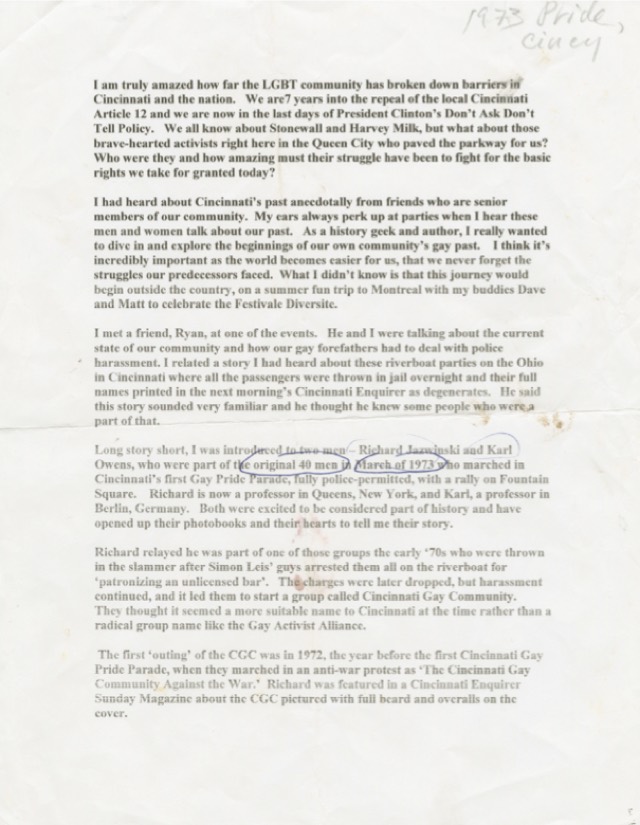
Report & history · c. 2011
A Brief History of Cincinnati's First Pride
Read PDF →
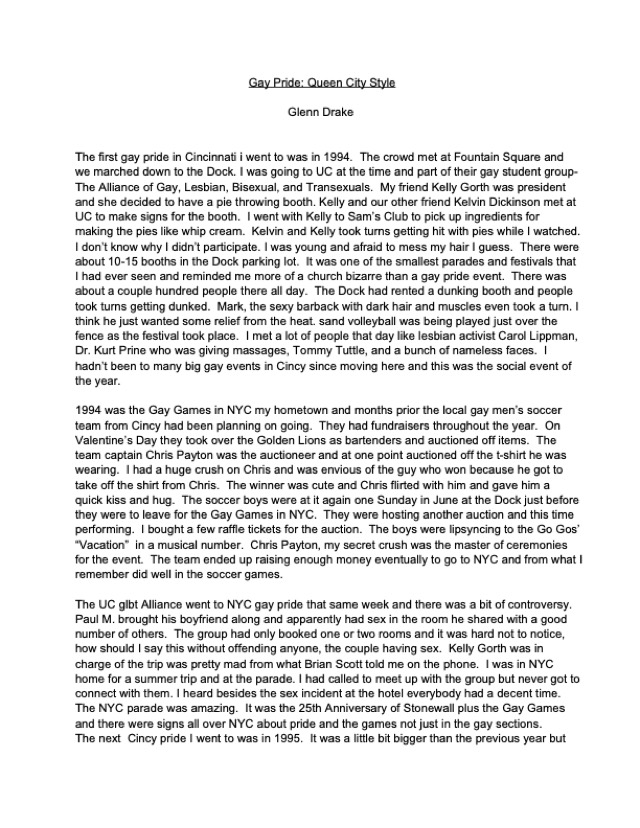
Report & history · 1994
Cincinnati Pride History
Read PDF →
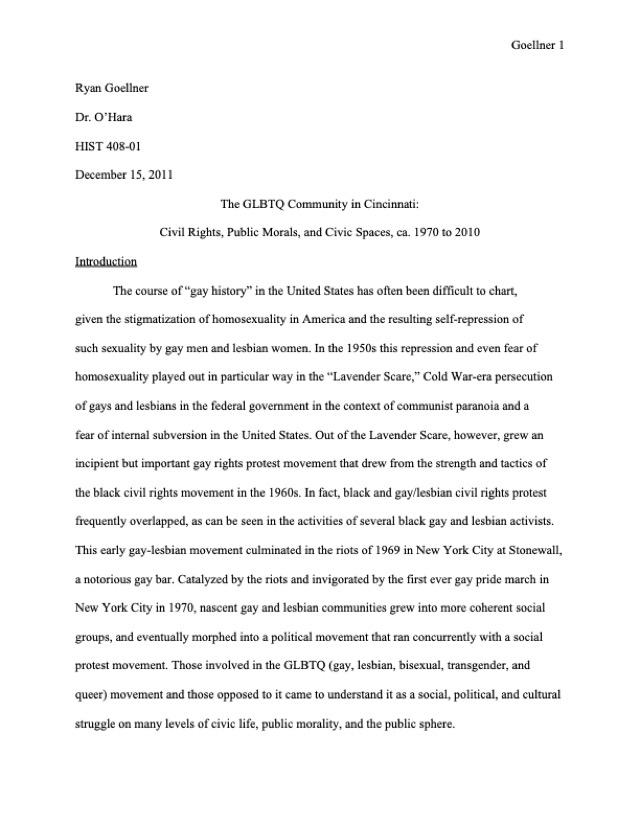
Report & history · June 15, 2011
The GLBTQ Community in Cincinnati: Civil Rights, Public Morals, and Civic Space, 1970–2010
Read PDF →
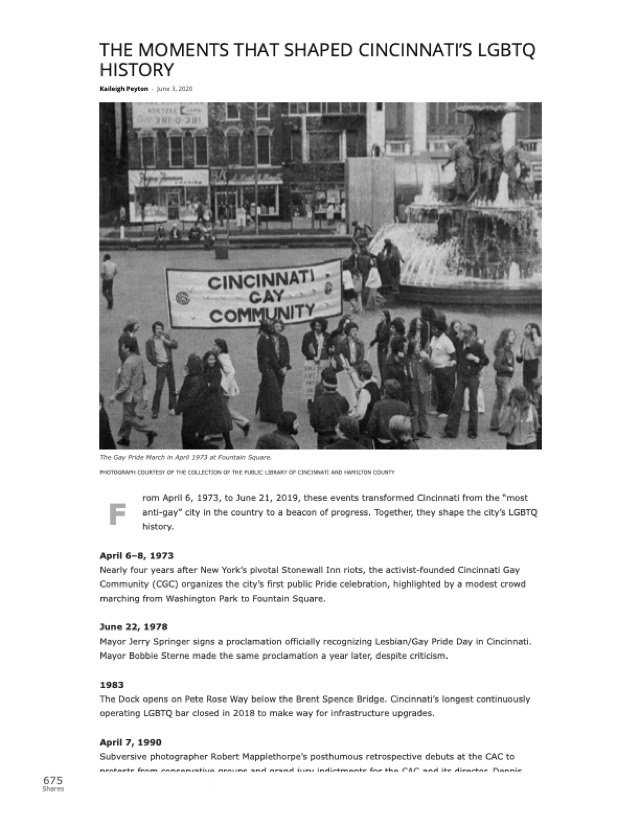
News article · June 3, 2020
The Moments That Shaped Cincinnati's LGBTQ History
Read PDF →